A plain reading from the team at Smart Safety Power of Realtime Biometrics. This is general information, not legal advice. For a specific decision, talk to a lawyer.
The short answer is yes. A private company in India can run biometric attendance on fingerprint or face. There are conditions, and most offices we install for are not aware of them, so this is worth ten minutes.
The conditions come down to three ideas. Tell your staff what you are collecting and why. Keep the data secure and delete it when you no longer need it. And do not force Aadhaar based attendance on private employees, which is a separate thing from ordinary fingerprint attendance and trips up a lot of people.
Which laws apply
Three sit on top of each other here.
The Information Technology Act of 2000 and its 2011 rules came first. Under those rules biometric information is classed as sensitive personal data, and an organisation collecting it is expected to have consent and a privacy policy.
The Digital Personal Data Protection Act of 2023 is the big one now. It was passed on 11 August 2023, and the rules under it were notified on 13 November 2025, rolling out in phases with full compliance expected by around the middle of 2027. So you are in a window where the law exists and the clock to comply is running.
The Aadhaar Act of 2016 matters only if you choose to tie attendance to Aadhaar. Most private offices should not, and the next section explains why.
What the DPDP Act means for an employer
The Act uses its own words. You, the employer, are the data fiduciary, the one who decides why and how the data is collected. Your employee is the data principal. The software or cloud vendor you use is a data processor, and you stay responsible even when they hold the data.
There is a genuine split among lawyers on consent, and it is worth knowing rather than guessing. The Act allows certain legitimate uses for employment without separate consent, and some firms read attendance as falling inside that. Other lawyers advise getting explicit, informed consent for biometric data specifically, because of how sensitive it is. The cautious path, and the one we would point a client toward, is to take consent and give notice anyway. It costs you a form. It saves you an argument later.
What is not in dispute: you must tell employees what you collect and why, keep the data only as long as you need it, secure it properly, and give people a way to raise a complaint. The penalties for getting data protection badly wrong are large. The Act allows fines up to 250 crore rupees for serious breaches. No attendance machine is worth that exposure, which is why the dull steps matter.
The Aadhaar question, where people slip
You have probably heard of AEBAS, the Aadhaar Enabled Biometric Attendance System. That is the government one. It started in 2014 under Digital India, it covers central government employees, and the data goes to a government portal run by NIC using UIDAI certified devices. It exists for government staff.
A private employer is in a different position. In the 2018 Puttaswamy judgment, the Supreme Court confirmed privacy as a fundamental right and struck down Section 57 of the Aadhaar Act, the part that had let private bodies demand Aadhaar by contract. The practical result is that a private company should not make Aadhaar based attendance compulsory for its staff. The government did move in 2025 to reopen some Aadhaar authentication for private entities under a new framework, but that area is still unsettled, and it is not the ground you want to build an attendance policy on.
The clean way around all of this is also the simplest. Run attendance on an ordinary fingerprint or face machine that stores the employee's biometric on the device or your own server, with no link to Aadhaar at all. That is a normal commercial system. It never touches the Aadhaar database, so the Section 57 problem never arises. Almost every system we install for private offices works this way.
The machine stores a template, not your fingerprint
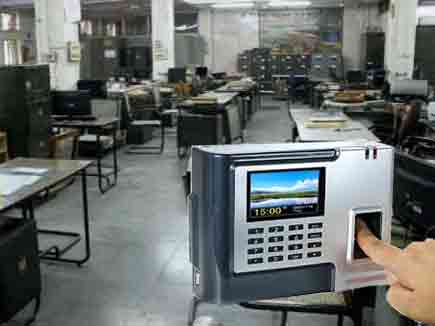
This one detail eases a lot of the worry, and it happens to be true. A fingerprint machine does not save a picture of your fingerprint. It converts the ridge pattern into a string of numbers, a template, and saves that. You cannot rebuild a usable fingerprint image from the template. Face machines work on the same principle, storing a mathematical map rather than a photo on file.
This is not a licence to be careless, because that template is still personal data under the law. But it does mean a well run system holds a coded reference, not a gallery of fingerprints, and that lowers the damage if anything ever leaks.
What a careful employer should actually do
None of this is complicated. It is a short list that most offices skip and later wish they had not.
- Give written notice. A one page note telling staff what is collected, why, where it is stored, and who to contact. Put it where people will see it.
- Take consent anyway, even if your lawyer thinks employment use covers you, and keep the signed forms.
- State the purpose and stick to it. Attendance data is for attendance and payroll. Do not quietly reuse it for something else.
- Secure the data with encryption and limited admin access, and use a vendor who can tell you how the data is protected. If the vendor goes blank when you ask, that is your answer.
- Sign a proper agreement with your software or cloud provider. Under the Act they are your data processor, and the responsibility still lands on you.
- Delete it when people leave. When an employee exits, their biometric template should be removed once you no longer need it for records. Holding it forever is the kind of thing the law is built to stop.
- Keep Aadhaar out of it unless a specific rule requires it, and offer a fallback for the rare person who genuinely cannot use the biometric.
Tell staff before you install, not after
The law wants you to give notice. So does common sense. The fastest way to make a new system unpopular is to bolt a machine to the wall on a Monday and let people work out for themselves what it is reading and where the data goes. Rumours fill the gap, usually the worst version.
A short briefing before installation does two jobs at once. It satisfies the notice requirement under the DPDP Act, and it kills the office gossip that a biometric machine is tracking people's every move. Tell them what it stores, that it is a coded template and not a photo of their finger, what it is used for, and that it stops at attendance and payroll. People accept a system they understand. They quietly resist one that arrives without explanation.
Where we fit
We set up systems that store the biometric template on the device or your own server, not tied to Aadhaar, which keeps private offices on the right side of all of the above. Our engineers can also walk your HR team through the notice and consent step during installation, so the compliance part gets done while the machine goes up, not bolted on in a panic later.
If you want to put a system in and stay clean under the DPDP Act, call 9319502447. Tell us your setup and we will recommend a configuration that does the job without collecting more than you should.
One caveat, repeated on purpose: this is general information based on the law as it stands, not legal advice for your company. For anything you are unsure about, run it past a lawyer who knows your situation.
Leave a Comment