From the install team at Smart Safety Power of Realtime Biometrics.
Two problems show up in almost every office still running on registers or swipe cards. Both are quiet, both cost money, and most managers already half know they are happening.
The first is proxy. One person marks a colleague present and the colleague stays home, or strolls in at eleven. The second shows up at month end, when the attendance numbers HR is paying salaries against do not match what happened on the floor.
A biometric machine deals with both, because it removes the one weak point they share: the ability to record a person who is not there.
The proxy problem, said plainly
On a card system, the card is the employee as far as the machine is concerned. Hand your card to a friend and you are present in the records while you are asleep at home. On a paper register it is even easier. Someone signs a row.
Most HR managers in Delhi offices suspect this is happening. The trouble is proof. You cannot discipline someone on a hunch, and the register gives you nothing to point at. So it continues, and over time it stops feeling like fraud to the people doing it. It becomes a small favour between colleagues.
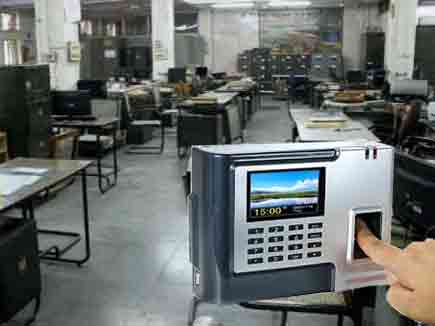
A fingerprint or face machine ends the favour. The finger has to be on the sensor. The face has to be in front of the camera. There is no token to hand over. By some industry estimates these systems block more than 99 percent of buddy punching attempts, and the reason is plain: the person has to physically be there.
What proxy actually costs
The hard numbers come mostly from the US, so treat them as a direction rather than a rupee figure for your office. The American Payroll Association estimates that time theft, which includes buddy punching, costs employers somewhere between 1.5 and 5 percent of gross payroll. The same body has reported that around three quarters of US businesses are affected by buddy punching in some form. Nucleus Research has pinned roughly 373 million dollars a year on buddy punching alone.
Run even the low end against an Indian payroll. Take a fifty person office. One and a half percent of your monthly salary outflow, paid every month for work that did not happen, is not a rounding error. It is a recurring leak, and it grows with headcount.
There is a harder version of this on sites that run contract labour. When you pay a contractor by headcount and the count comes off a register, the gap between names on paper and bodies on site is where money quietly goes. A machine that reads each worker closes that gap, because a name with no face or finger behind it does not get counted.
Then there is overtime. On manual systems overtime is where the numbers go soft. Hours get added generously, nobody can check them, and the person approving salaries signs off on figures they cannot verify. A machine that logs the real in and out time takes the guessing out of it.
Why the logs hold up
A biometric punch is timestamped the moment it happens, and on our setups it locks. Admin access lets HR run reports and fix genuine errors through an approval trail. It does not include quietly editing someone's in-time after the fact. A record that cannot be backdated is what turns attendance from an argument into a fact. When a salary dispute comes up, you have a log, not two people remembering the same morning differently.
Late marks and half days, applied the same to everyone
There is a softer cost that nobody puts on an invoice: inconsistency. On a manual system the late mark rule bends. A favoured employee gets a pass, someone else gets docked, and the rest of the floor notices. That resentment is real, and it costs you in ways attendance reports never show.
A machine applies the same rule to everyone because it does not know who it likes. If the policy is a grace period of ten minutes and a half day after a cut-off, the system marks it the same for the manager and the office boy. You can argue with the policy. You cannot argue that it was applied unfairly. For a lot of the HR people we deal with, that even-handedness is worth as much as the payroll saving.
The payroll half nobody mentions in the showroom
The machine on the wall is step one. The work happens in the software behind it.
On most old systems, attendance lives in the device and payroll lives in a spreadsheet, and a human carries the numbers across by hand every month. That manual step is where most errors are born. A misread row, a skipped leave, a wrong overtime total, and the salary goes out wrong.
The attendance software connected to a proper machine closes that gap. It calculates hours worked, tracks leave balances, flags overtime, and exports a payroll ready report. For a company with branches in Noida, Gurgaon, and elsewhere, the cloud dashboard pulls every location onto one screen, so HR is not chasing each office on the 30th. The offices that feel the difference fastest are the ones that were losing whole days to month end data assembly.
What it will not fix
We would rather tell you this now than after installation.
A biometric machine records the truth. It does not enforce it. If your data shows three people clocking in at 10:40 every day and nobody acts on it, the machine has done its job and the lateness continues. The system hands you proof. The discipline is still yours.
It will not read damaged fingers reliably either. If your staff work with their hands in ways that wear the skin, fingerprint will fight you and you should be on face recognition instead.
And it only works if enrolment is done properly on day one. A rushed enrolment, with bad finger scans, creates rejections that make everyone hate the system. Our engineers handle this during installation and train your HR staff to add new joiners correctly, which is half the reason a rollout sticks.
Does it really pay for itself in two months?
We say on our site that for an office above about fifteen people, where attendance accuracy matters, the system tends to pay for itself within two months. That figure is arithmetic, not a slogan. The device is a one time cost. The recovered payroll leakage, the overtime you can now verify, and the HR hours freed from manual entry usually add up to more than the machine cost within a couple of pay cycles. Smaller offices take a little longer, and that is fine. The honest answer is that the smaller and more honest your team already is, the less you need this.
Where to start
If proxy or a month end payroll mess is the reason you are reading this, the fastest way to judge a system is to watch it run on your own floor. We bring the device to your office across Delhi NCR and around twenty five cities, set it up, and let your HR team try the software and the reports. There is no charge for the demo.
Call 9319502447. Tell us your headcount and how you track attendance now, and we will tell you straight whether a machine will move the needle for you, or whether your problem sits somewhere a machine cannot reach.
Leave a Comment